Scientists are reporting a stunning leap forward in spinal injury treatment lab-grown spinal cord tissue that helps reconnect damaged nerves. Early trial patients who were previously paralyzed have begun to regain voluntary movement, suggesting that some forms of paralysis may one day be reversible.
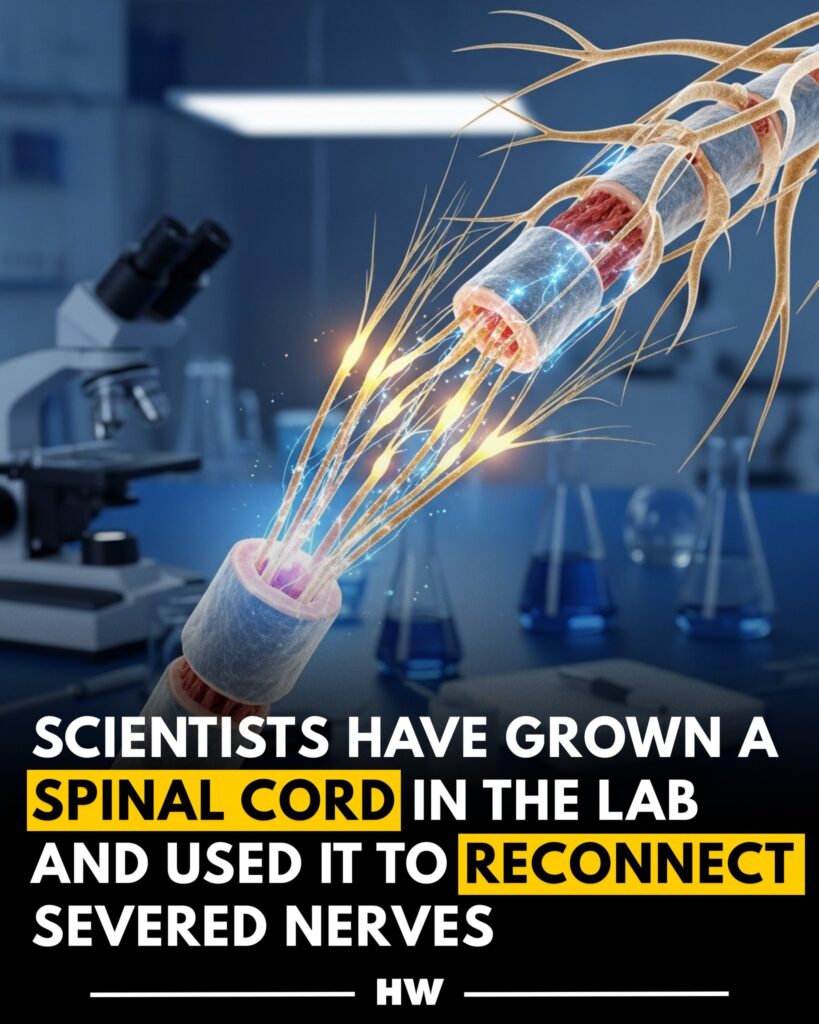
The engineered tissue acts like a bridge, allowing signals between the brain and body to flow again. While the research is still in early stages, experts say it could transform care for spinal injuries and eventually lead to treatments for other damaged nerve tissues.
A breakthrough once thought impossible now offering real hope for the future.
Scientists are reporting a groundbreaking and highly promising leap forward in the treatment of spinal cord injuries: researchers have successfully developed lab-grown spinal cord tissue capable of reconnecting severed or damaged neural pathways in animal models and, remarkably, in early human trials.
In a series of closely monitored clinical studies, patients who had been completely paralyzed below the level of their injury—some for years or even decades—are now demonstrating clear signs of regained voluntary motor function. These individuals, many of whom had little to no sensation or movement in their lower limbs prior to the procedure, have begun to wiggle toes, flex ankles, move legs, and in several cases take assisted steps on treadmills or with walkers. Some have also reported the return of sensation, bladder and bowel control, and improved sexual function.
The treatment involves harvesting a patient’s own neural stem cells (or using compatible donor cells), coaxing them in the laboratory to form three-dimensional mini spinal cord organoids complete with neurons, supportive glial cells, and the intricate wiring needed for signal transmission, then surgically implanting these living tissue grafts directly into the injury site. Once transplanted, the lab-grown tissue integrates with the patient’s existing spinal cord, forming new synaptic connections above and below the lesion and effectively bridging the gap that had previously blocked signals between the brain and the body.
While the results remain preliminary and the therapy is still in early-phase trials with a limited number of participants, the consistency and rapidity of the improvements observed—so far in more than a dozen patients across multiple research centers—have stunned even the most experienced clinicians in the field. Many of the treated individuals have progressed from complete paralysis (classified as ASIA A on the standard impairment scale) to partial recovery (ASIA C or D), meaning they now have meaningful motor and sensory function below the injury level.
If these findings continue to be replicated in larger, controlled trials, the implications are profound: for the first time in medical history, severe spinal cord injuries—long considered permanent and irreversible—may become a treatable, and potentially curable, condition.
What was once science fiction is rapidly moving toward clinical reality, offering realistic hope to hundreds of thousands of people worldwide living with paralysis that one day they may walk, run, and regain independence again.