Before leaving for a well-earned vacation, most people meticulously work through a mental checklist of tasks designed to ensure that the house stays secure and problem-free while they’re away. Doors are double-checked to confirm they’re locked; appliances are unplugged to prevent electrical surges or wasted energy; perishable foods are tossed to avoid moldy discoveries upon return. Some travelers even go the extra mile—adjusting thermostats, setting light timers, watering plants, or asking neighbors to keep an eye on packages. Yet among all these common pre-departure rituals, one detail is frequently and surprisingly forgotten: the sink drain. It’s an item so ordinary, so integrated into everyday life, that most people don’t give it a second thought unless it clogs. But overlooking this small feature can lead to unpleasant consequences that greet you the moment you step back inside your home after days or weeks of relaxation. A drain left uncovered can become a gateway for foul odors, dampness, or even invasive insects that find their way into quiet, unused plumbing. Travelers often assume their home will be just as they left it, clean and still, but plumbing systems don’t take vacations. While you’re away, the hidden networks of pipes running through your walls and beneath your floors continue responding to environmental conditions—heat, humidity, pressure changes, and evaporation. And because sinks are connected directly to sewage systems or gray-water lines, the drain opening becomes a potential path for whatever lies below. What seems like a harmless oversight can create an unwelcome sensory assault upon your return, turning what should be a peaceful homecoming into an immediate cleanup mission.
To understand why an uncovered drain can be problematic, it helps to look at one of the most overlooked but essential components of home plumbing: the P-trap or U-shaped pipe located beneath every sink. This curved portion of the pipe holds a small pool of water at all times, and that water acts as a protective barrier against sewer gases rising from deeper in the system. Under normal circumstances—when the sink is used daily—this water is continually replenished, keeping odors securely blocked. However, when a house sits empty for days, especially in hot or dry climates, the water trapped in that bend can slowly evaporate. As the water level drops, the seal weakens, and eventually, it breaks entirely. Once that happens, the pipe becomes a direct channel between the sewer system and your living space. The gases that rise through the plumbing aren’t just unpleasant; they can include methane and other compounds that create musty or sulfur-like smells that settle into fabrics, carpets, and furniture. These odors can be stubborn and difficult to eliminate once they take hold. Beyond smells, evaporated traps also open the door—quite literally—for insects. Insects such as gnats, drain flies, ants, cockroaches, and even sewer roaches can crawl upward through the pipes when there’s no water barrier to stop them. In warm weather, insect populations grow rapidly, and an unused drain offers a dark, moist, sheltered environment that makes an ideal entry point. Homeowners often return from vacation confused about why bugs appeared out of nowhere, only to discover that their sinks unknowingly served as gateways. Even if your home is normally spotless, plumbing lines are shared environments, and insects simply follow the path of least resistance. When the trap dries up, the path leads straight into your kitchen or bathroom. And because insects are naturally drawn to still, damp spaces, a quiet, unused home provides exactly the conditions they prefer. All of this makes the humble sink drain far more significant than most travelers realize.
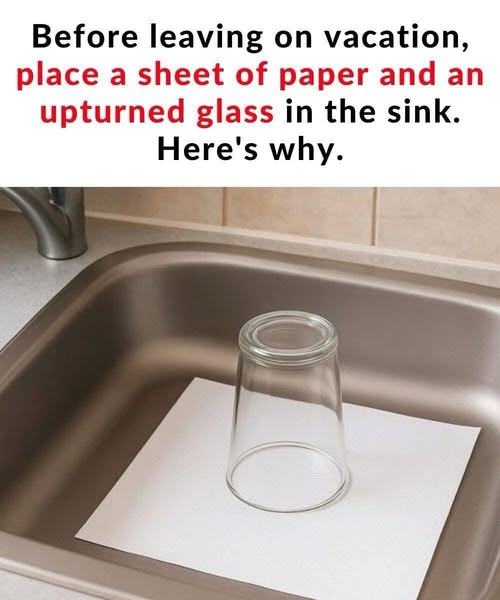
Fortunately, preventing these issues is remarkably easy, and it doesn’t require expensive gadgets or specialized tools. Plumbers often recommend a simple, cost-free solution that works more reliably than traditional drain plugs: cover the drain with a paper towel and place an upside-down glass over it. At first glance, the method may seem too simple or even too improvised to be effective, but its effectiveness lies precisely in its simplicity. Rather than relying on a mechanical seal, which can fail under heat or pressure changes, the glass acts as a physical barrier that stays firmly in place regardless of temperature or humidity. The paper towel adds an extra layer of odor absorption and helps ensure that even the smallest insects cannot squeeze through microscopic gaps. Unlike sink stoppers—which can become loose, shift slightly, or warp if exposed to warm temperatures—an inverted glass keeps the drain fully covered without forming an airtight seal that could inadvertently trap moisture. Plumbers favor this method because it’s universally applicable: every household has spare drinking glasses and paper towels, and the materials can be used on nearly any sink shape or size. It’s also non-invasive; it doesn’t alter or stress the plumbing system, doesn’t require chemicals or adhesives, and can be applied in seconds. The barrier created by the overturned glass blocks rising air, smell, and bugs while allowing the area to remain dry. In this way, the technique addresses multiple potential problems at once. Even if the trap water were to evaporate completely during your absence, the glass and towel prevent anything unpleasant from making its way into the home. This method also has the advantage of being easy to remember because it visually signals that the sink has been “closed for vacation.” When you see the glass sitting there, you know the drain has been secured.
For travelers who want to take even more thorough preventive steps before leaving home, a simple pre-vacation sink preparation routine can provide extra protection and peace of mind. Start by cleaning the sink thoroughly—removing food particles, soap residue, or grease—which can contribute to odors or attract bugs if left behind. A clean sink also minimizes bacterial growth, especially in warm weather. After cleaning, pour hot white vinegar down the drain. Vinegar is a natural disinfectant and deodorizer, and its acidity breaks down residue that may be coating the inner walls of the pipes. Allow the vinegar to sit for a few hours so it can fully dissolve buildup and neutralize lingering smells. When the waiting period is over, rinse the drain with warm water to flush everything away. Next, take a fresh lemon wedge and rub it generously around the drain opening and the surrounding basin. Lemon not only adds a clean, bright fragrance but also contains natural antibacterial properties. The oils in lemon peel cling to the drain surface, leaving behind a subtle scent that endures even after you’ve left. Once the sink is clean, disinfected, and rinsed, dry the area thoroughly. Dryness is especially important because moisture attracts insects and encourages mold or mildew. After drying, place a folded paper towel over the drain opening and set a glass upside down on top of it. The weight of the glass keeps the towel in place, and the towel absorbs any small traces of moisture that might linger. This multi-step preparation helps ensure that when you close the door behind you, your sink—and the plumbing beneath it—is as fresh and protected as possible. It’s a small ritual that takes less than ten minutes but can save you from hours of cleaning or troubleshooting when you return.