Mom… Get Under the Bed.’ I Had Just Given Birth—Then Heavy Footsteps Entered My Hospital Room”
I had just given birth when my eight-year-old daughter slipped into the hospital room, eyes wide and alert, and the kind of fear she carried made my heartbeat change before she even spoke.
Rebecca wasn’t the dramatic type.
She was the kind of child who played brave, who told jokes when adults argued, who felt safe inside hospitals because hospitals meant help, not danger.
So when she closed the curtains like she was sealing us inside a secret, I knew something outside them had teeth.
She pressed a finger to her lips, rushed to my bedside, and whispered so close to my ear I could feel her breath shaking against my skin.
“Mom… get under the bed. Right now.”
My stomach clenched, my body still weak from labor, my mind trying to reject the instruction because new mothers are taught to be calm, not to crawl on the floor like prey.
But Rebecca’s eyes weren’t begging.
They were commanding.
They held the certainty of a child who had seen something adults must not see, and that certainty is the most terrifying thing in the world.
I slid off the bed carefully, every muscle protesting, my gown tangling around my legs, the room spinning for a second as if my body didn’t understand why we were suddenly hiding.
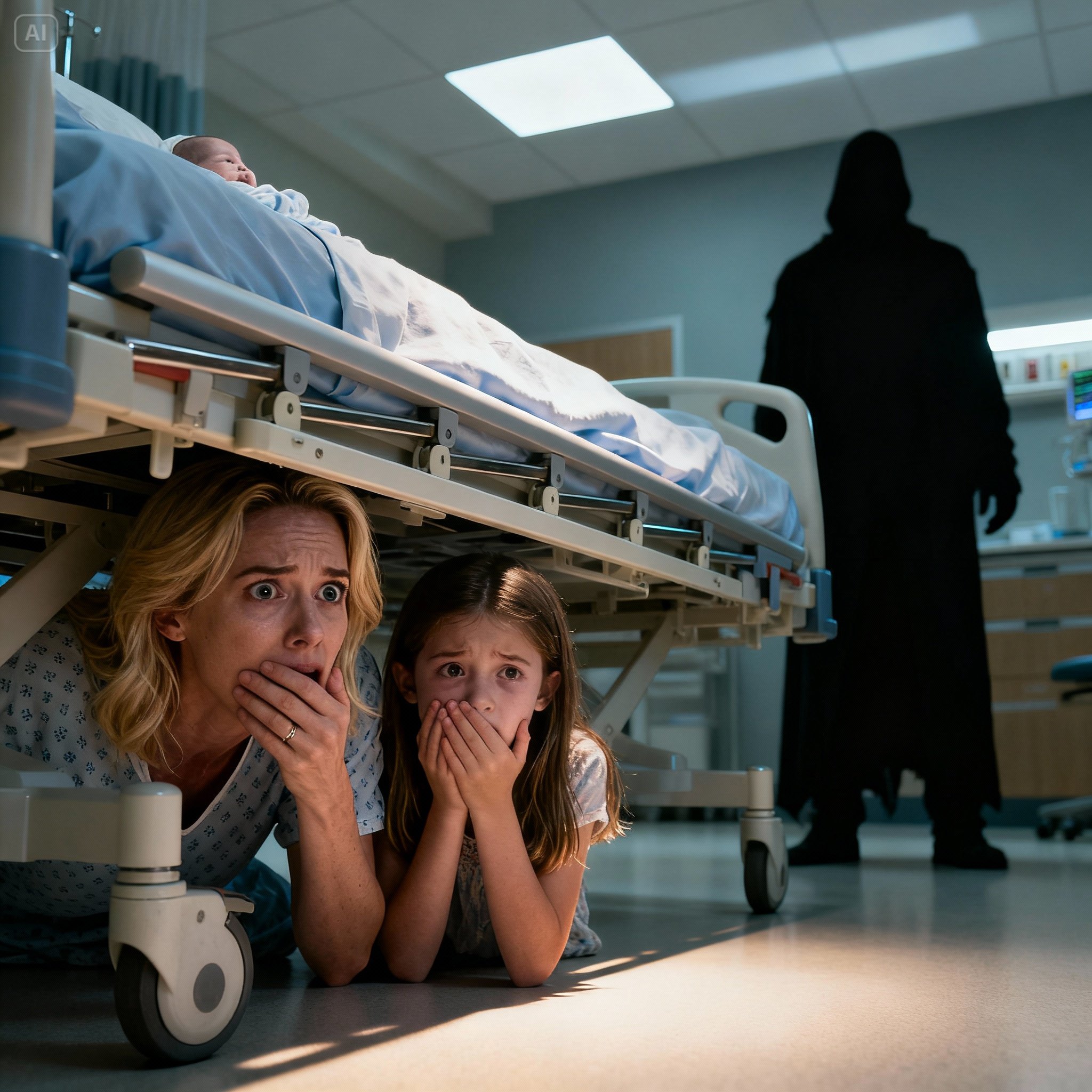
Rebecca gripped my hand and guided me down, her small fingers shockingly cold, and together we crouched and pulled ourselves beneath the hospital bed.
The floor smelled faintly of disinfectant and metal, and I could hear the soft machine hum that usually comforts patients, except now it sounded like a countdown.
We lay pressed close in the shadow, my heart hammering hard enough I was afraid it would betray us, and Rebecca’s hand moved to my mouth like she already knew I’d gasp.
The newborn slept in the bassinet, unaware that the world had shifted, unaware that her first hours of life were being measured in silence.
A moment later, heavy footsteps entered the room.
Not the light, efficient steps of a nurse.
Not the soft shuffle of a doctor in a hurry.
These steps were slow and deliberate, with the weight of someone who was not supposed to be there but felt entitled anyway.
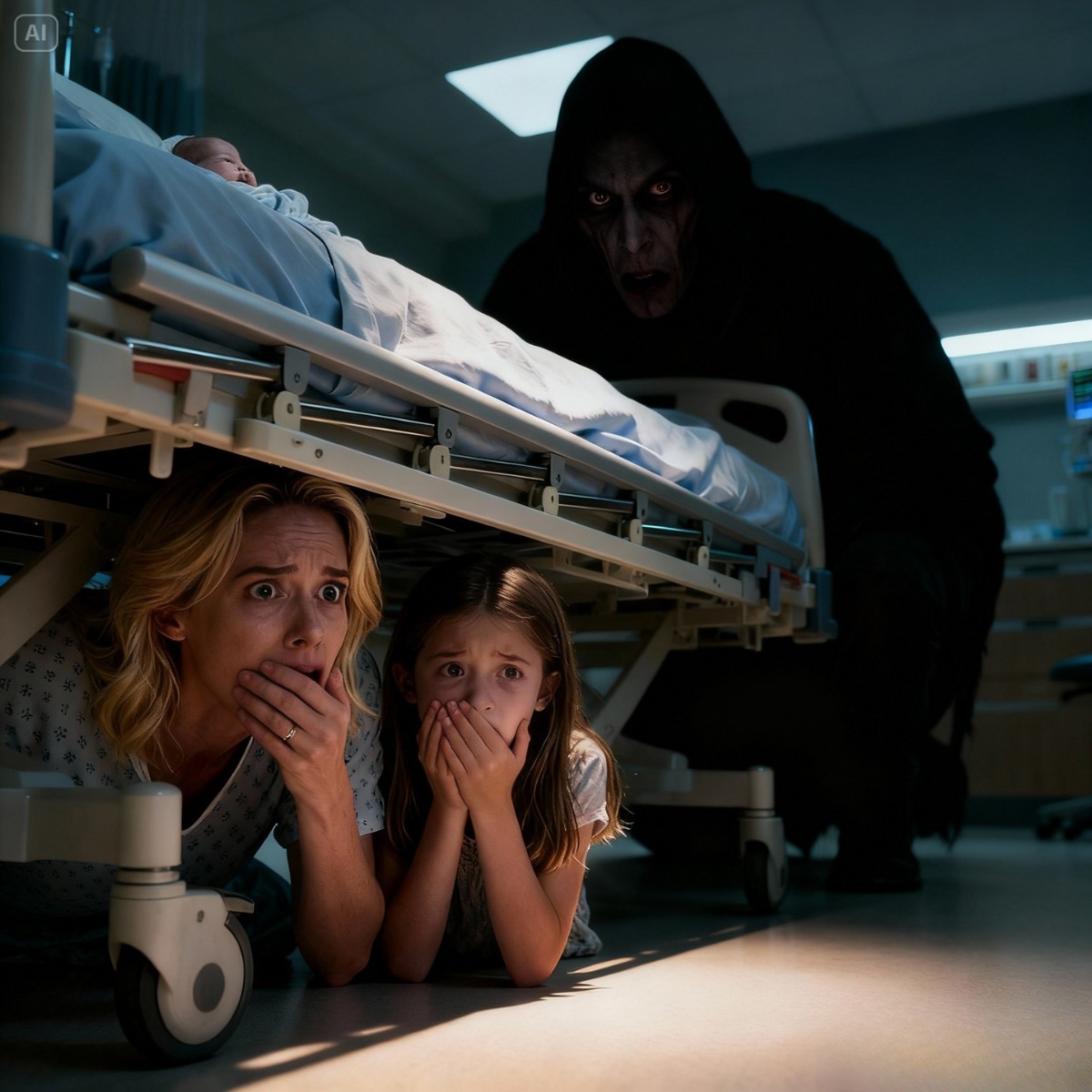
My eyes adjusted in the dim under the bed, and through the narrow gap I saw the lower half of a figure, shoes darker than standard hospital footwear, standing just beside the bassinet.
The figure didn’t speak.
They didn’t greet me.
They didn’t check monitors.
They simply stood there, as if listening for something, as if the room itself needed to confirm we were alone.
Rebecca’s body went rigid against mine, and her hand tightened over my mouth so gently it felt like love, yet so firmly it felt like survival.
I tried to tilt my head for a better view, and Rebecca’s eyes snapped to mine with a silent warning: do not move.
The figure shifted, and I heard the soft scrape of plastic, like someone touching the bassinet rail, and a wave of panic rose so fast it made my vision blur.
I wanted to sit up and scream, because motherhood is instinct, and instinct says protect the baby, but instinct doesn’t always know how to beat a predator.
I forced myself to stay still, because Rebecca—my child—was trusting that hiding was the only way we lived through the next minute.
The figure leaned closer to the bassinet, and I saw a gloved hand appear in the gap, not medical gloves, but thicker ones, the kind people wear when they don’t want fingerprints.
My blood ran cold.
Hospitals are full of strangers, yet they’re built on one assumption: strangers here are regulated, watched, registered, accountable.
This hand looked like it wanted to be invisible.
The figure reached down toward the baby, and my whole body screamed to move, but Rebecca pressed her palm just a fraction harder over my lips, and I felt her tiny chest shaking.
She was terrified too, yet she was controlling her fear for me, and that realization shattered something inside my heart.
Because no eight-year-old should ever have to be the brave one.
Then, from the hallway, a voice called out, “Room 314? Nurse needed in 314,” and the figure froze, like an animal caught by sudden light.
The gloved hand withdrew quickly, and the heavy shoes stepped back, then turned toward the door with the same deliberate pace, as if rushing would attract attention.
The door opened just slightly, and for one sharp second I saw a sliver of a face reflected in the glass panel—partially covered, eyes scanning—then it was gone.
The door clicked shut again, and silence returned like a blanket thrown on a fire.
Under the bed, Rebecca finally lifted her hand from my mouth, and I sucked in air so hard my throat burned, trying not to sob loud enough to summon whoever had been there.
“What did you see?” I whispered, voice cracked, and Rebecca’s eyes shone wet as she answered in the smallest breath.
“I saw him,” she said.
“Who?”
“The man in the blue jacket,” she whispered, and I felt my mind scramble because hospital staff wear scrubs, not jackets, and visitors don’t walk in like they own the room.
Rebecca said she’d been drawing in the waiting area when she saw a man arguing quietly with the receptionist, flashing something quickly—like a badge or a card—then walking fast down the hallway.
She said he looked angry, not sick, and he kept glancing around like he didn’t want anyone to notice where he was going.
Then she said the sentence that made my stomach drop all the way through the floor.
“He asked me where your room was,” she whispered, “and when I didn’t answer, he smiled at me like I was stupid.”
My hands started shaking, because the idea of any stranger asking a child for my room number made the hospital feel suddenly unsafe, like the walls were paper.
I reached for the call button from the side of the bed above us, stretching my arm up blindly until my fingers hit it, and I pressed it once, twice, three times.
A nurse entered within a minute, and the moment she saw a woman and a child under the bed, her professional calm cracked into alarm.
“Ma’am, what happened?” she asked, and I tried to explain between breathless words, pointing at the bassinet, describing the shoes, the gloves, the silence.
The nurse checked the baby first, then moved to lock the door, and when she did, I noticed something chilling that made my skin crawl.
The door latch looked slightly scratched, like someone had tried keys more than once.
Security arrived quickly, and the room filled with the kind of official urgency that makes you feel both relieved and furious, because you realize how close danger can get before anyone pays attention.
They reviewed hallway footage, called the front desk, questioned staff, and when they asked Rebecca to describe him, she spoke with a clarity that broke my heart.
Average height, blue jacket, dark cap, a lanyard that didn’t match staff patterns, and eyes that never softened even when he smiled.
One guard muttered that there had been a recent incident in another wing involving an unauthorized person posing as family, and hearing that confirmed my worst fear.
This wasn’t a one-time mistake.
It was a pattern.
While they searched, I held my newborn with trembling arms, and Rebecca sat beside me, shoulders stiff, face too pale for a child, like her innocence had been asked to do adult work.
The doctor on call came in and spoke quietly, telling me they would move us to a different unit, assign a guard, restrict visitors, and put a password on my name at reception.
I nodded, but my mind kept circling the same brutal question.
If Rebecca hadn’t followed her instinct, if she hadn’t run, if she hadn’t demanded we hide, what would have happened in those silent seconds by the bassinet.
That night, after they relocated us and the hallway finally felt watched, I asked Rebecca what made her so sure we needed to hide, because children don’t usually plan escape routes.
Rebecca stared at the blanket and whispered, “Because he wasn’t looking for you, Mom.”
She swallowed, and her voice nearly disappeared.
“He was looking at the baby pictures on the wall.”
In our unit, the maternity hallway had framed newborn photos and welcome posters, and suddenly I felt sick understanding that someone had come with intention, not curiosity.
Rebecca said the man’s eyes fixed on those photos the way an adult’s eyes fix on a target, like he was confirming something before moving.
I reported everything, signed statements, and watched nurses add new protocols to our chart, and still I couldn’t shake the feeling that we’d survived only by a child’s courage.
The next morning, security returned with an update that made my skin go colder, because they had found the man’s entry point.
He had used a badge that belonged to someone else.
A stolen badge.
And the staff member it belonged to had reported it missing the day before, assuming it had been misplaced, not weaponized.
The hospital promised an investigation, promised cooperation with police, promised that “this is rare,” yet rare doesn’t comfort you when it almost touched your child.
In the days that followed, my family tried to turn the story into luck, into “thank God nothing happened,” but I couldn’t accept luck as a safety plan.
Rebecca saved us, and that truth carried a bitter taste, because childhood shouldn’t include tactical thinking under fluorescent lights.
Before we were discharged, I hugged Rebecca so tightly she squirmed, and I told her she did the right thing, that she was brave, that she listened to her instincts.
She didn’t smile like she usually did.
She just looked at me and whispered, “I didn’t want him to take her,” and the simplicity of that sentence broke me more than the fear ever did.
Because the scariest part wasn’t the footsteps, or the gloves, or the quiet.